
KEEP NEWS
Mary Denise Owusu Adjeiwa Advances Power Systems Engineering with KEEP Support
Published: 25 Mar 2026
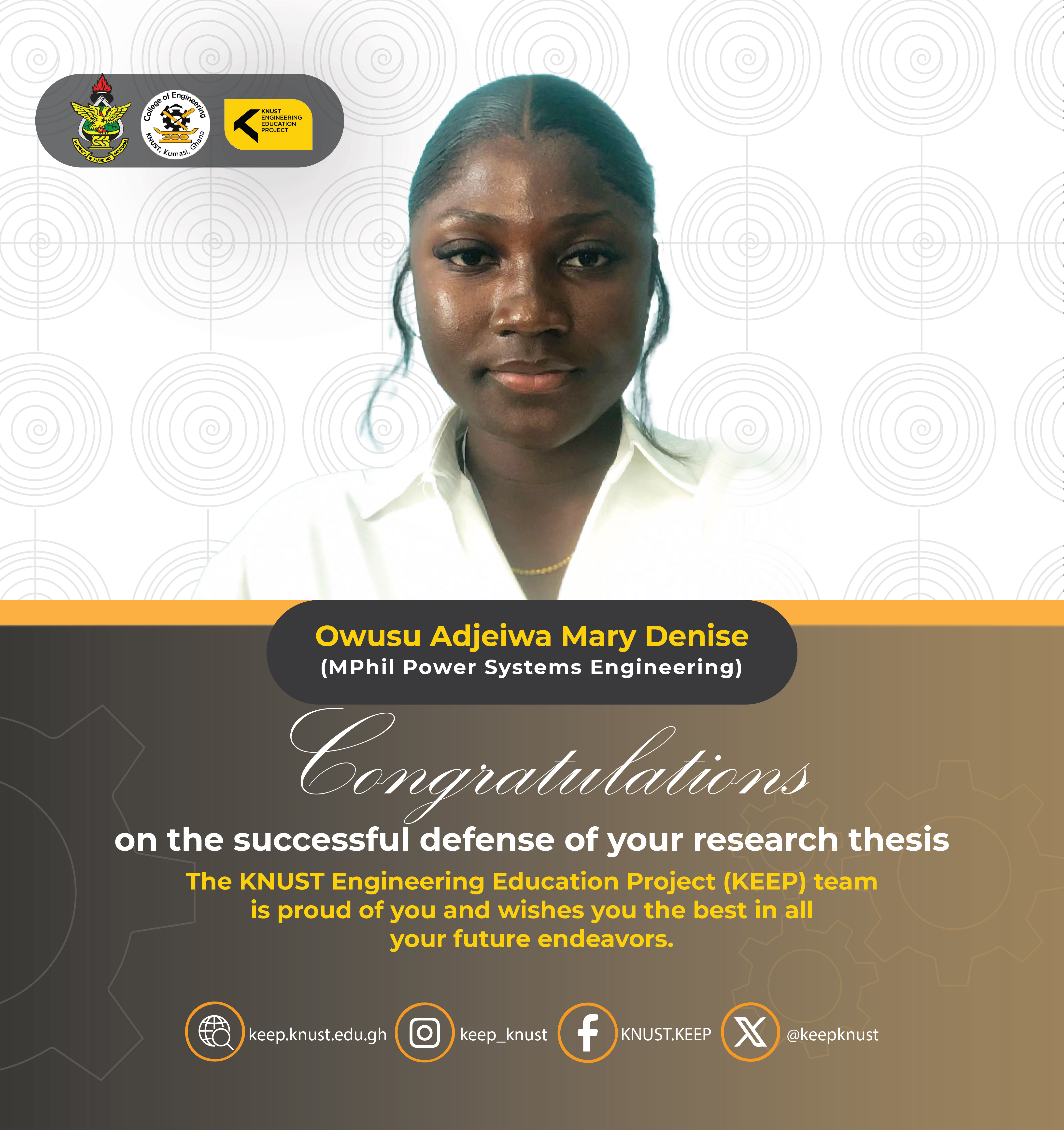
The KNUST Engineering Education Project (KEEP) celebrates the achievements of Ms. Owusu Adjeiwa Mary Denise, who has completed her MPhil in Power Systems Engineering. Her research addresses critical challenges in off-grid and rural electrification through innovative, data-driven methodologies.
Ms. Denise’s research interests lie at the intersection of Renewable Energy Systems (RES), Hybrid Energy Storage Systems (HESS), and power system optimisation. For her MPhil thesis, she developed a novel, expert-driven multi-criteria decision-making framework known as HC-OT-BFAHP. This sophisticated model integrates hybridised criteria weighting, optimal transport theory, and a Bayesian-based fuzzy analytic hierarchy process to effectively manage uncertainty and subjectivity—key challenges in complex energy planning.
By incorporating expert judgement with advanced uncertainty modelling, her work enables the identification of robust, reliable, and cost-effective energy system configurations. This approach ensures that system designs are not only technically sound but also sustainable and resilient, with significant implications for off-grid communities.
Ms. Denise acknowledges the invaluable guidance and support of her supervisors, Dr. Elvis Twumasi and Prof. E. A. Frimpong, whose expertise was instrumental to the success of her studies.
She also extends her sincere gratitude to the KNUST Engineering Education Project (KEEP) for enriching her academic journey. Through a transformative internship opportunity provided by KEEP, she gained essential practical experience and expresses her deep appreciation for the support received from its staff and management.
Looking ahead, Ms. Denise plans to build on her strong foundation by pursuing further research in data-driven decision-making and advanced optimisation techniques. Her future work will focus on AI-driven optimisation and uncertainty modelling for resilient hybrid renewable energy systems. By integrating machine learning with probabilistic and fuzzy frameworks, she aims to enhance real-time decision-making, system reliability, and adaptive energy management within smart grids and off-grid applications.
KEEP is proud to have supported Ms. Denise’s academic journey and looks forward to her continued contributions to the field of sustainable energy engineering.