KEEP NEWS
KEEP Scholar Impact: The Journey of Dr. Rahimat Oyiza Yakubu
Published: 15 Jul 2026
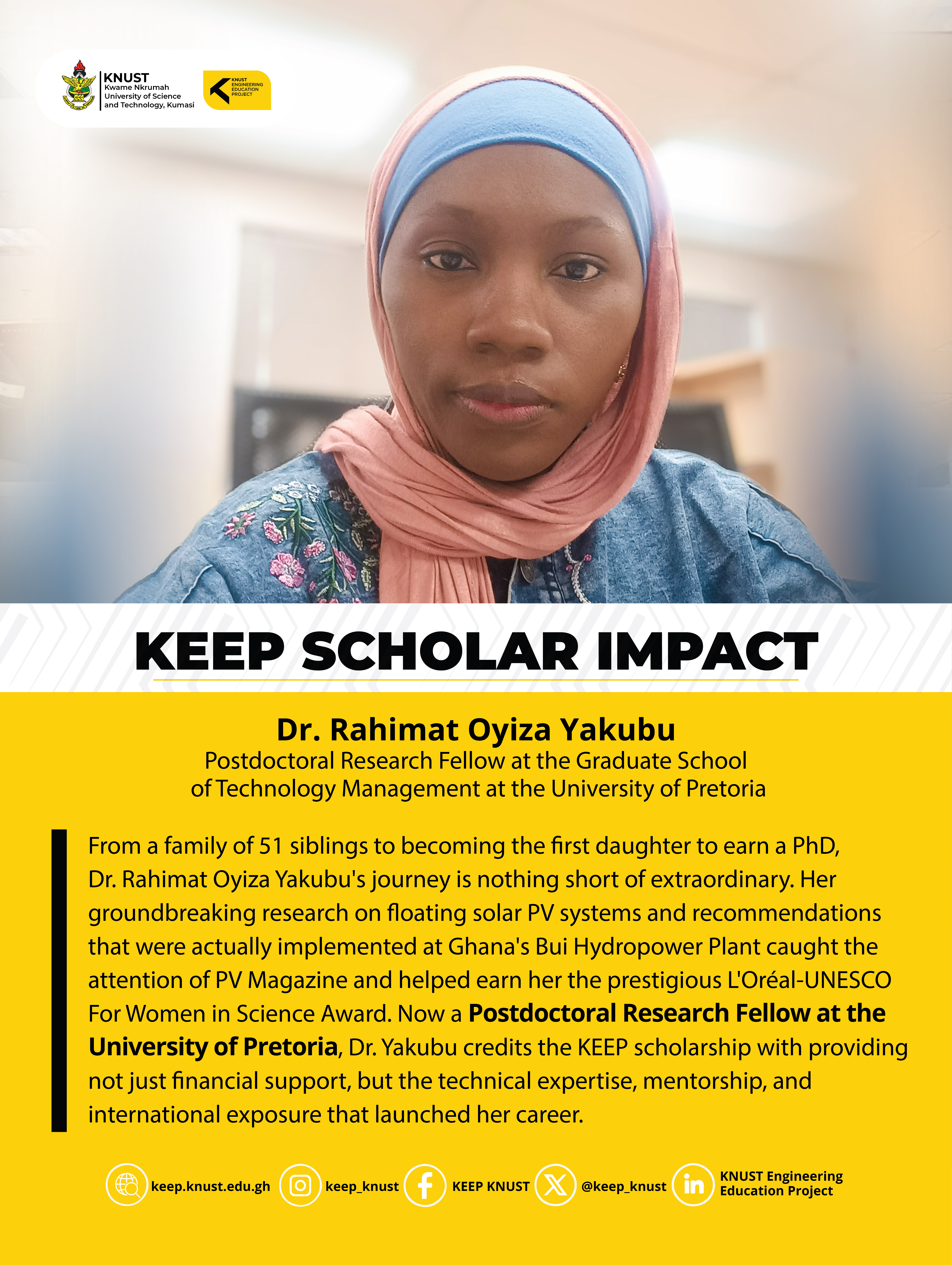
Dr. Rahimat Oyiza Yakubu is a remarkable example of how the KNUST Engineering Education Project (KEEP) is transforming lives and advancing sustainable energy research across Africa.
Dr. Yakubu's passion for energy began in elementary school when she learned to connect a battery to a small light bulb. "From that moment, I knew that I wanted to study something related to electricity and light," she recalls. This early fascination, combined with natural aptitude in physics and mathematics during secondary school, led her to pursue both a BEng and an MEng in Electrical Engineering at the Federal University of Technology, Minna, Nigeria, in 2010 and 2018, respectively.
The KEEP programme came to her attention through two meaningful connections. Her elder brother, Professor Kovo Abdulsalam, a Professor of Chemical Engineering at the Federal University of Technology, Minna, Nigeria, shared the application link after colleagues from his department met KEEP officials at a conference in Nigeria. Additionally, a dear friend, Latifa, mentioned the programme after learning about it through her elder sister.
For Dr. Yakubu, the value of the KEEP scholarship extends far beyond financial support. Coming from a very large family with 51 siblings on her father's side, she became the first daughter in her family to obtain a PhD, a milestone she describes with profound gratitude.
"The value of the financial support I received through KEEP is immeasurable," she states. The scholarship covered tuition fees, provided healthcare support, and offered a stipend for living expenses, enabling her to concentrate fully on her studies and research.
The KEEP programme provided her with an invaluable opportunity to undertake an internship at a hydropower plant at Kainji Dam, Minna, Nigeria, which shaped one of the key objectives of her PhD research. Her work assessed the technical optimisation and performance of floating photovoltaic and ground-mounted photovoltaic systems, research that had immediate practical applications in the integration of a hybrid hydro solar PV plant.
The findings and recommendations from her research were implemented during the second-phase installation of the 5 MW floating PV plant at the Bui Hydropower Plant. This represents the kind of practical, impactful research that the KEEP programme aspires to foster. Her work was featured by PV Magazine, a leading global trade media platform dedicated to the solar photovoltaic and energy-storage industries.
Today, Dr. Yakubu is a Postdoctoral Research Fellow at the Graduate School of Technology Management at the University of Pretoria, working within the Sustainable Energy Research Group. Her research focuses on modelling and techno-economic assessment of offshore renewable energy systems, AI data centres, and their integration with renewable energy systems. She also supervises a master's dissertation and mentors graduate students.
Her career journey has included roles as a Graduate Assistant at Nile University, work at a thermal power plant and power equipment department in Ajaokuta, Nigeria, and consultancy projects for government institutions.
The impact of the KEEP programme on Dr. Yakubu's academic journey is reflected in the prestigious recognition she has received. In 2023, she was awarded the L'Oréal-UNESCO For Women in Science Sub-Saharan Africa Young Talents Award, a testament to how effectively the KEEP programme prepared and empowered her to excel as a woman in science.
She has also received a research-stay award to conduct research at Brandenburg University of Technology Cottbus–Senftenberg in Germany, where she will focus on the economic and financial assessment of energy-transition systems.
Dr. Yakubu credits the KEEP programme with equipping her with a valuable combination of technical expertise and professional skills. "On the technical side, I gained advanced knowledge of sustainable energy technologies, energy-system modelling, techno-economic analysis, and the life-cycle assessment of clean-energy systems," she explains.
Beyond the classroom, she developed strong competencies in research, project management, and scientific writing, skills instrumental in publishing her work and communicating findings effectively. The programme also strengthened her leadership, teamwork, and cross-cultural collaboration skills through its regional and international networks.
Looking ahead, she hopes to make meaningful contributions to the energy sector, particularly within the African context. "I want my research and professional work to support the development of sustainable, affordable, and reliable energy systems that respond to Africa's unique needs and challenges," she shares.
Equally important to her is improving access to education for out-of-school children, particularly girls. "I hope to use my journey, experience, and future achievements to inspire and support young girls from disadvantaged backgrounds to pursue education and realise their full potential."
Dr. Yakubu's story exemplifies the transformative power of the KEEP programme, not only in advancing sustainable energy research but in empowering first-generation scholars to become leaders who will shape Africa's clean-energy future. Her journey from a curious child connecting batteries to light bulbs to an internationally recognised researcher demonstrates the profound impact of accessible education and dedicated mentorship.